
Forensic entomology Understand article
Are you a biologist with a mission? Do you want to fight crime with science? Martin Hall and Amoret Brandt from The Natural History Museum in London, UK, introduce the fascinating (and smelly) field of forensic entomology.
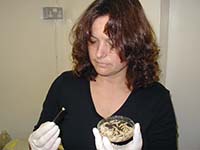
Forensic entomology is the study of insects and other arthropods in a legal context. The applications are wide-ranging, but the most frequent is to determine the minimum time since death (minimum post-mortem interval, or PMI) in suspicious death investigations. This is done by identifying the age of the insects present on a human corpse, which can provide a relatively precise estimate in circumstances where pathologists may only be able to give a broad approximation. The fundamental assumption is that the body has not been dead for longer than it took the insects to arrive at the corpse and develop. Thus, the age of the oldest insects on the body determines the minimum PMI.
Two examples of this are:
- A body discovered in the summer in southern England had suffered extensive burns, making the pathologist’s interpretation of the conventional post-mortem changes in the body very difficult. Ageing the blowfly larvae on the body indicated that the first fly eggs had been laid on the body six days before. Witnesses subsequently testified that the fatal fire was observed on the night before the estimated day of egg-laying.
- A body discovered in late winter in northern England was well preserved because of the cold temperatures, and pathological evidence suggested that the person had died two to three weeks before. In contrast, insect evidence suggested that the person had died more than two months before the body was discovered. This was consistent with other evidence and was accepted by the coroner’s court.

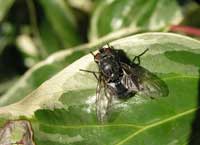
(below) adults of the
common bluebottle blowfly,
Calliphora vicina (Diptera:
Calliphoridae)
The insects of greatest value to forensic entomology are blowflies (family Calliphoridae), because they are usually the first insects to colonise a body after death, often within hours. Because of this, the age of the oldest blowflies gives the most accurate evidence of the PMI. Many other species of fly, beetle, wasp and moth are also associated with cadavers, resulting in a succession of insects arriving at the body, but as they tend to arrive after the blowflies, they are less useful in establishing a PMI.
Blowfly infestations of human bodies are a natural outcome of the flies’ role in the environment as primary decomposers. The ubiquity of fly larvae on carrion is clear to anyone who comes across the dead body of a hedgehog or rabbit while walking in the country. The larval infestations might look gruesome, but they are a vital component of the natural recycling of organic matter and, on human bodies, they can provide vital clues to the timing and cause of death.
Adult blowflies are well adapted to sensing and locating the sources of odours of decay, so cadavers are quickly found. Eggs are usually laid in the natural orifices (e.g. eyes, nose, mouth, ears) or other dark and moist places, such as the folds of clothes or just under the body. Eggs hatch into first instar larvae that grow rapidly, moulting twice to pass through second and third instars until they finish feeding. Depending on the species, they pupate on the body or move away to find a suitable site. They may move many metres before burrowing into the soil or under objects such as rocks and logs or, if indoors, under carpets and furniture. The larva then contracts and the cuticle hardens and darkens to form the barrel-shaped puparium, within which the pupa metamorphoses into an adult fly. When the fly emerges, the empty puparial case is left behind as long-lasting evidence of the insect’s development.
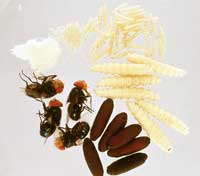
(clockwise from bottom left):
adults, eggs, first instar
larvae, second instar larvae,
third instar larvae, puparia
containing pupae
The rate of development of all insects is directly dependent on the ambient conditions, particularly temperature. Between upper and lower thresholds, which vary between species, the higher the temperature, the faster the insects will develop; the lower the temperature, the slower they will develop (see graph left). If the ambient temperatures during the period of development are known, then, in theory, the minimum PMI can be determined.
However, there are many complicating factors that affect the rate of development of larvae on a body:
- Temperature (which can depend on geographical location, indoor or outdoor exposure, sun or shade, time of day and season)
- Heat generated by the ‘maggot mass’
- Food source (tissue type, e.g. liver, heart, lungs)
- Contaminants and toxins (external and internal)
- Burial or other obstructions (e.g. plastic sheets, water) that hinder access and egg-laying by adult insects.
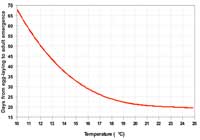
development of the immature
stages of blowflies with
temperature, based on
published data for the
bluebottle blowfly Calliphora
vicina (Diptera: Calliphoridae)
All of the above need to be considered when estimating a PMI, yet for many of them, little information is available. For example, the elevated temperature due to the ‘maggot mass’ can be readily appreciated by any angler reaching into a bowl of bait maggots, but quantifying its effect on larval development still requires detailed study, for example using novel thermal imaging techniques (see box).
The degree to which a forensic entomologist is involved in a case can vary. The entomologist may attend the crime scene personally to collect the insect specimens from the body or its surroundings. This is ideal, because he or she can use knowledge of insect biology and behaviour to make sure that as many specimens as possible are collected and to help interpret the results. Alternatively, the entomologist may collect insect specimens during the post-mortem examination as well as viewing photos of the crime scene or visiting the scene after the body has been removed. Finally, the specimens may be collected by the police, for example, ideally after telephone consultation with the entomologist. Photographs of the scene and the post-mortem examination will then be shown to the entomologist.
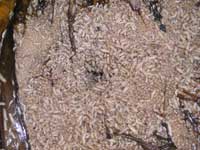
feeding on a human body,
many head down, in a
maggot mass at a
temperature approximately
15 慢 above ambient
When investigating a suspicious death, the main questions which need to be answered by the forensic entomologist are:
Which species of blowfly are present on the body? The collected specimens must be correctly identified, so that all of the relevant information on physiology, behaviour and ecology of that insect species can be used. This question is answered by taxonomy, one of the most neglected of the natural sciences but the foundation for all others.
Which are the oldest specimens of blowfly? They may still be feeding on the body; they may have left the body to pupate elsewhere; or they may have already emerged as adults and left behind their empty puparial cases.
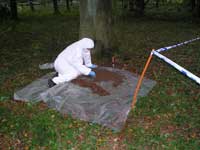
a gravesite for insect
specimens. The initial search
at the scene is made on a
plastic sheet, before bagging
the samples for further
analysis in the laboratory.
Note the use of full
protective clothing
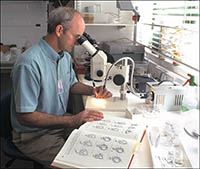
How old are the oldest specimens? Estimating age involves detailed morphological study of the insects under a binocular microscope, to determine their stage of development and to compare that with data from standard databases relating developmental stage to age at different temperatures (see next question).
What were the ambient temperatures at the scene while the flies were developing on the body? An electronic temperature data logger is placed at the crime scene for seven to ten days and the readings are compared with data from the meteorological station over the same period. This comparison and the data from the meteorological station for the time before the discovery of the body can then be used to estimate the temperatures during that period at the scene of the crime. This determines the temperature at which the larvae developed.
Forensic entomology is a relatively young science, so there are many areas which need further investigation. DNA studies are currently being carried out to determine genetic differences between fly species and also between populations of the same species, which could help to determine whether a body has been moved after the initial infestation. Extracting and analysing the gut from larvae which have been feeding on a body may help determine whether drugs were present in the body, suggesting a suicide or overdose. Gunshot residue in the larval gut would indicate a shooting when physical evidence no longer exists. It is even possible that human DNA could be extracted from larvae, showing the previous presence of a body, even when that body has been removed, leaving the larvae behind.
The most common species of blowfly can be found all year round, but the effect of cold on the different life stages of blowflies has been poorly studied. A greater understanding of this subject would be valuable, as the slow rate of development in cold periods allows useful PMI estimates to be made much longer after death than is possible in summer. Further research would help to improve the accuracy and robustness of case reconstructions based on forensic entomology.
Thermal imaging
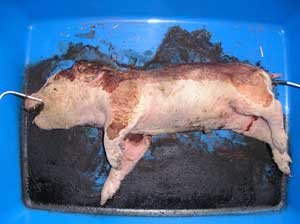
Scientists at The Natural History Museum, London, UK, are just beginning to explore the thermal dynamics of larval masses using infrared photography. The temperature of individual blowfly larvae can be measured (below right). The still-born piglet (below left) appears untouched by insects in a normal photograph, but thermal imaging indicates an active larval mass in the throat and chest regions (below right) that causes an increase in temperature where the larvae are feeding.
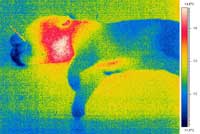
shown with thermal imaging
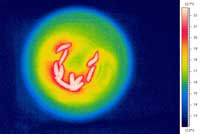
blowfly larvae, measured
using thermal imaging
Interview with a forensic entomologist
After a zoology degree and a masters in taxonomy and biodiversity, Amoret worked on various groups of insects, such as hoverflies and wasps, and spent three years rewriting The Handbook of British Fleas. In search of more applied work, leading to a career in entomology, she then moved into forensics. She is studying part-time for a PhD at King’s College London, as well as doing casework in forensic entomology at The Natural History Museum.
“I think the most interesting thing about the job is the variety and uncertainty of it. You never know when the phone’s going to ring. Every case is different, and I guess one of the hardest things is never quite knowing what you’re going to be confronted with.
“Casework constantly raises new questions, and makes you realise how little we know, even about the most common of insects. For instance, a couple of years ago, we were asked to visit a crime scene to search for puparial cases. The problem was that the crime was two years old, and no research has been done on how long empty puparial cases remain intact in the soil. So I started a study where I buried a large number of empty puparial cases and over a period of three years I dig them up. The results should be able to tell us the rate at which the puparial cases degrade over time, at least over a three-year period. So the next time we’re faced with an ‘old’ crime, we’ll be better able to help.
“Probably the most fascinating thing I’ve done is to work at the Anthropological Research Facility (or Body Farmw1, as it is also known) at the University of Tennessee in Knoxville, USA. This is the only place in the world where the decomposition of humans can be studied, so it’s an amazing opportunity to study the succession of insects on humans, rather than pigs, which is what we usually use.
“There’s no obvious route to getting into forensic entomology, but I believe that being an entomologist first, and then branching into forensics, is the right way to do it. You need the training and skills of an entomologist to understand the ecology and behaviour of the insects you’re dealing with.”
Web References
- w1 – The Body Farm
Resources
- Readers interested in forensic entomology are encouraged to consult the following publications and websites for further information: Byrd JH, Castner JL (eds; 2000) Forensic Entomology: the Utility of Arthropods in Legal Investigations. Boca Raton, FL, USA: CRC Press
- Catts EP, Haskell NH (eds; 1990) Entomology and Death: a Procedural Guide. Clemson, SC, USA: Forensic Entomology Associates
- Erzinçlioglu Z (2000) Maggots, Murder, and Men: Memories and Reflections of a Forensic Entomologist. Colchester, UK: Harley Books
- Goff ML (2000) A Fly for the Prosecution: How Insect Evidence Helps Solve Crimes. Cambridge, MA, USA: Harvard University Press
- Greenberg B, Kunich JC (2002) Entomology and the Law: Flies as Forensic Indicators. Cambridge, UK: Cambridge University Press
- Smith KGV (1986) A Manual of Forensic Entomology. Ithaca, NY, USA: Cornell University Press
- American Board of Forensic Entomology
- European Association for Forensic Entomology
- Forensic Entomology
- North American Forensic Entomology Association
Review
This article is engaging and fascinating for all teachers, as it deals with the inevitable decay after death. It gives an interesting insight into the area of forensic science, which is quite popular today, as shown by many television series on the subject.
The language and the content of the article are easily understood. The biological (entomological) forensic approach is particularly fascinating, as the most common view of this topic is biochemical or medical. This article shows that you have to work in an interdisciplinary way to solve crimes. Sherlock Holmes is indeed dead – instead the scientist, police officer and legal team are all necessary. Maybe this will inspire teachers to work across disciplines more often?
Unfortunately, any classroom activity with meat and blowflies would be too disgusting and smelly, but if a creative person could come up with a good idea to reduce the bad smell, it would be a very fascinating task for students.
Paula Starbäck, Sweden
Paula Starbäck, Sweden