

Awards, rewards – and onwards! Inspire article
At Science on Stage 2, the European Science Teaching Awards 2007 were presented for the 12 best projects. Eleanor Hayes, editor of Science in School, describes how the jury made their difficult decisions
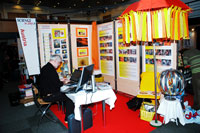
Image courtesy of ILL
The unbelievable noise of 500 science teachers demonstrating their experiments, their materials and their ideas in the science teaching fair: the most intriguing, explosive and multilingual marketplace you’ve ever seen! The nose-tingling smell of innumerable chemical reactions. And the unforgettable sound of one Romanian delegate singing a song composed specially for the occasion…. It could only be Science on Stage!
At the Science on Stage 2 festival in Grenoble, France, the eight-person jury spent a week prowling around the fair: the heart of the event. We had €18 000 worth of European Science Teaching Awards to allocate: four cash prizes and eight organisational prizes (including sponsored visits to research institutes, laboratory equipment and books). Twelve prizes, 30 countries and 500 delegates – selected by their countries to represent the very best in European science education. How could we possibly choose?
Image courtesy of ILL
Our key criteria were innovation, relevance in school and reproducibility: was it new, could other teachers copy it, and did it matter? Sounds easy, but the competition was impressive. So much inspiration, such professional student-made equipment – and above all, such enthusiasm for science and education!
Our search for innovative teaching led us to Per Kornhall, from Sweden, with his ambitious project to ‘Teach Science in a Different Way’ (EPS Prize). As tired of basic physics as his students were, he had jumped straight in with molecular orbitals, relativity, stereochemistry, the Big Bang and quantum theory. The result? Students’ attendance and their respect for science rose noticeably.
The very small and the very large can be particularly challenging to teach, especially without expensive equipment. We were therefore happy to be pounced on by Zoltán Köllö, from Hungary, who had created a number of clear and simple models, including a demonstration of nuclear fusion and the Coulomb barrier using a couple of drops of water! Impressed by his ideas and enthusiasm, we awarded him the fourth-place cash prize (€1000). Also a fan of the simple simulation, Panayiota Neophytou from Cyprus (EMBL Prize) and her students created an innovative 3D model of the animal cell, using cheap and readily available materials. What an effortless and fun way to learn difficult words like ‘mitochondria’.
Image courtesy of ILL
Moving from the minute to the immense, Ida Regl, from Austria, encouraged her primary-school students to pose questions about the Sun and then design and perform their own experiments to answer them. And what questions! The ambitious ‘Sunny Side Up’ project covered not only light refraction, colours, heat and gravity, but also Sun flares, Sun granulation, sunspots and photovoltaics. Ida received a well-earned third-place cash prize (€2000).
The Sun played a vital role too in Mario Mitov’s Bulgarian demonstration of an ecological energy system. Energy from a solar panel or wind turbine was used to electrolyse water, and the resultant hydrogen and oxygen produced electricity in a reversible fuel cell. Designed by students, the modular apparatus will be commercialised to provide Bulgarian teachers with inexpensive and flexible equipment – and won Mario the second-place cash prize (€3000).
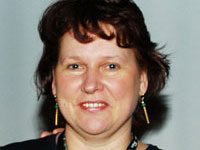
Image courtesy of ILL
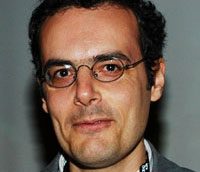
Image courtesy of ILL
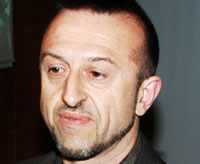
Image courtesy of ILL
In our hunt for interdisciplinary work, we were bowled over by Angela Köhler and her ‘Chemistry Under the Pyramids’ project (ESRF Prize), in which she and her students rediscovered chemistry used by the ancient Egyptians. On the German stand, Angela showed us how to mummify an apple, synthesise Egyptian Blue pigment, and recreate ancient Egyptian cosmetic recipes – one of the jurors claimed the marigold (Calendula) salve was very effective.
Herbs were particularly important in Nils Bernt Andersen’s ‘Juicy Greens’ student enterprise (EFDA Prize). Algal waste from a local factory– together with suitable school refuse – was used to investigate the most effective way to make compost. That done, the students grew organic herbs and vegetables – and sold them to local restaurants from their green-painted bicycle.
Merlange and Jean-Paul
Chamozzi from France
Image courtesy of ILL
Continuing the theme of a healthy diet, we came across Gianluca Farusi from Italy. His ‘Looking for Antioxidant Food’ project (ILL Prize) encouraged students to eat more healthily by introducing them to the many diseases associated with free radicals and getting them to compare the antioxidant activity of different foods. The conclusion? Drink more espresso!
One criterion for the jury was whether the project could be easily used in other European schools. And what could be more useful than the books, DVDs and CD-ROMs developed by Patric Pacella from Luxembourg (CERN Prize)? Dissatisfied with the available textbooks, he has created a resource for all chemistry teachers – and has filmed just about every chemical reaction you would want to do at school, plus plenty that you could never do yourself because they are too expensive or dangerous.
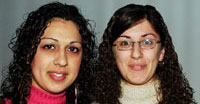
colleague from Malta
Image courtesy of ILL
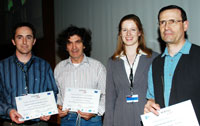
Not only fascinating and instructive but also beautiful: Vincent Devaux, Michel Merlange, Jean-Paul Chamozzi and their French students (ESA Prize) designed underwater bubble machines. The students developed several different submarines powered by effervescent tablets, which used Archimedes’ principle and cleverly shaped components to roll, bob or rotate through a tank of water. These were accompanied by bilingual films telling the story of the submarine captain’s daring manoeuvres.
Storytelling was also central to Claudia Bezzina’s Maltese project (ESO Prize), which linked historical stories with simple scientific experiments, capturing the imagination of students and jury alike. Her student booklet will be published soon.
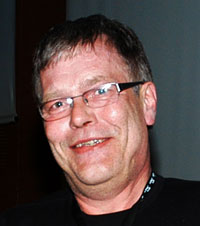
Denmark
Image courtesy of ILL
Finally, our top prize of €4000 went to Finn Skaarup Jensen from Denmark for ‘Robots in Real Life’. His build-it-yourself robot kits not only look appealing, but demonstrate mechanics, hydraulics and electronics to students aged 13 and upwards.
During the week, we heard with delight about the continuing work of the CERN prize-winners from Science on Stage 1. After winning their prize for using lichens to measure water quality, Maria das Mercês Silva e Sousa and Maria Joao Carvalho not only convinced two universities and a factory to join their school project but also succeeded in changing Portuguese national policy on water quality! We look forward to hearing from our latest batch of prize-winners: how have you developed your ideas and did the award help?
Although the noise, smell and music may fade, the longer-lasting benefits of Science on Stage will remain: the international collaborations and friendships that were forged, the ideas that were shared and developed, and the motivation of all participants. Congratulations to our 12 prize-winners, but also to everyone who brought and shared such impressive projects and made science so much fun!
References
- More information about the festival and the awards is available on the Science on Stage website.
- Many of the projects demonstrated at Science on Stage 2 will be published in forthcoming issues of Science in School – watch this space!
Institutions
 Science on Stage