


Healthy horrors: the benefits of parasites Understand article
Matt Kaplan investigates the horrors that dwell within us – should we be changing our view of them?
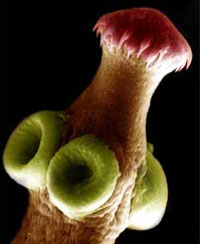
equipped with two rings of
hooks and four suckers to
anchor itself to the host’s
intestine
Image courtesy of the Institute
for Parasitology, University of
Bern, Switzerland
The definition of what it is to be a healthy human has been a somewhat stable one for more than a hundred years. In general, dictionaries list good health as a state that is free of infirmity and disease, yet research conducted in the past decade is beginning to throw this classic definition into question as the results of a number of studies suggest that various disease-causing organisms play a key role in managing the health of many animals.
One of the most straightforward examples of this involves the parasitic tapeworm genera Anthobothrium and Paraorigmatobothrium. Just like any other tapeworm, they soak up nutrients from digested food while sitting inside animal guts.
However, instead of sitting inside the guts of dogs, cats or humans, these worms spend their days residing in the guts of sharks, robbing the predators of nutrients by absorbing them before the sharks can. Whereas small numbers of tapeworms simply force the animals they infest to feed more often, large populations can make host animals very ill.
Yet, a research study conducted by Masoumeh Malek at the University of Tehran in Iran and a team of colleagues found that these parasitic worms might provide a critically valuable service to their hosts.

Image courtesy of qldian /
iStockphoto
After dissecting 16 whitecheek sharks (Carcharhinus dussumieri) found in the Persian Gulf and removing tapeworms that they found, the team compared the concentrations of different compounds found inside the tissues of the sharks and the worms. They discovered that the worms had astonishing 278 to 455 times higher levels of the toxic metals cadmium and lead inside their little bodies than the sharks did.
So these worms, while stealing some nutrients from the sharks’ guts, are likely providing an invaluable service to the sharks by functioning as filters that protect the predators from becoming poisoned by heavy metals (Malek et al., 2007).
Findings like those in this study are throwing the definition of a parasite into confusion. Parasites are supposed to take what they need, harm their host in the process, and give nothing in return. In contrast, organisms called mutualists provide a benefit to their host and receive some benefit in return; organisms called commensals provide a benefit to a host but do not get anything in return. What role the shark worms, which are traditionally considered to be parasites, are playing is difficult to determine. And such confusion is not unique to shark parasites; many parasites that have a penchant for using humans as hosts are also raising questions.

the aggression of the
immune system?
Image courtesy of Eraxion /
iStockphoto
The confusion started in the 1970s, when chronic allergy sufferer and researcher John Turton, then at the UK’s Medical Research Council, decided to intentionally infect himself with parasitic hookworms, Necator americanus. His actions might sound insane, but he suspected that something about having parasites to fight would make his immune system change its behaviour and reduce his allergic reactions. Remarkably, Turton’s self-experimentation worked, and he reported in the Lancet, a medical journal, that his allergic reactions were reduced for the two years that the parasites were living inside him (Turton, 1976).
The logic behind Turton’s actions relied on the idea that allergies, eczema and asthma are overreactions of the immune system. Under normal circumstances, the immune system searches for harmful organisms and destroys them. However, in patients suffering from allergy, eczema and asthma, the immune system attacks not only harmful organisms, but also materials that are not actually a threat.

consequences of an
overreactive immune system
Image courtesy of BigPappa /
iStockphoto
Worms, because they have spent millions of years being attacked by the host’s immune system, have developed defensive mechanisms to help them thwart it. One of the most effective of these is the release of specific compounds to desensitise the host’s immune response, causing the immune system to detect fewer invaders in the body, so that parasites are less likely to be harassed.
Damping down the immune system may sound like a bad thing. To some extent it is, particularly when parasites are taking advantage of it. Yet researchers at the University of Nottingham, UK, speculate that, after millions of years of evolution, the human immune system is so used to being attacked by parasites that without them present, it sometimes malfunctions, becoming overly aggressive when they are not around.
Although Turton’s work certainly made a point, his experiment only involved a single participant, himself. Good science however requires studies with many participants, and repeated experiments to confirm results. David Pritchard and his colleagues at the Nottingham University School of Pharmacyw1, UK, are seeking to do exactly this.
For years, Pritchard’s team has been looking at allergy and asthma prevalence in both developing countries, where parasitic worms are common, and developed countries, where they are almost entirely absent. They have confirmed the results of many colleagues, who find that allergies are often absent in regions where parasitic worms are commonly found inside people. This may suggest that parasites protect people from allergies and asthma, but because so many other conditions differ between developed and undeveloped countries, which may also play a role, it is impossible to be sure.

Image courtesy of CT757fan /
iStockphoto
The only way to find out for certain if such parasites really play a role in keeping the human immune system functioning properly is to infect a large number of allergy, eczema and asthma sufferers with parasitic worms, and to closely monitor their conditions to see if their allergies and asthma become less severe over time when compared to a control group of sufferers who were not infected.
Such experiments with asthmatics are currently in progress in Nottingham. Further work with worms may be warranted, depending on how patients respond to the treatment.
Of course, even if the research proves that parasites can help treat allergic conditions, the question remains whether many people would be willing to follow in Turton’s footsteps, swallowing a mouthful of worm larvae as a medicine. Luckily, they may not have to: at Strathclyde University in Glasgow, UK, a team of researchers led by William Harnett is experimenting on a complex protein that is created by a parasitic worm (Acanthocheilonema viteae) which infects rodents. Their research suggests that even in the absence of the worm, the isolated protein has the ability to reduce allergic inflammationw2.
Although much work is needed to fully understand what this protein is actually doing, there is a real potential in trying to use parasite proteins to control conditions such as allergies, asthma and eczema. Perhaps the public would find this solution a little more palatable?
References
- Garner S, Thomas R (2010) Evaluating a medical treatment. Science in School 16: 54-59. scienceinschool.org/2010/issue16/clinical
- Malek M et al. (2007) Parasites as heavy metal bioindicators in the shark Carcharhinus dussumieri from the Persian Gulf. Parasitology 134(7): 1053-1056. doi: 10.1017/S0031182007002508
- Turton JA (1976) IgE, parasites, and allergy. The Lancet. 308(7987): 686. doi:
 10.1016/S0140-6736(76)92492-2
Web References
- w1 – To find out more about the work of David Pritchard and his colleagues, see: www.nottingham.ac.uk/pharmacy/people/david.pritchard
- w2 – For more information about William Harnett’s work, see: http://spider.science.strath.ac.uk/sipbs/staff/Billy_Harnett.htm
- w3 – To find out more about the author, Matt Kaplan, see: www.scholarscribe.com
Resources
- To learn about further research into worm parasites, see:
- Wilson A, Haslam S (2009) Sugary insights into worm parasite infections. Science in School 11: 20-24. scienceinschool.org/2009/issue11/schistosomiasis
Review
This article is an excellent introduction to the different types of interactions between organisms and could be used in many ways.
Several types of parasite are discussed in the article. Where do we meet parasites in everyday life? Students might, for example, thinks of endoparasites like worms in cats, dogs and aquarium fish or of ectoparasites such as ticks, lice and leeches. In which organ systems do these parasites occur and what effects do they have on their hosts? Perhaps the students could investigate the dangers and uses of leeches throughout history. They could also investigate the life cycle of a particular parasite and think about how its anatomy is adapted to its way of life.
The article goes on to investigate the interaction of parasites with the immune system and could be used to introduce a discussion about the immune system, its constituents and regulation. What about when the immune system itself causes problems? How much do the students know about asthma and allergies? Do any of them suffer from allergies? What are the causes, how can these allergies be treated in the long run and how should the students react in an emergency?
The author then introduces the idea of using parasites or parasite extracts to treat allergy conditions. How much do the students know about conventional medicine? Perhaps they could discuss antibiotics and bacterial resistance, and whether they think parasites could, in future, be used as an alternative or supplementary medicine? They could also discuss how new treatments are developed and tested (see Garner & Thomas, 2010).
Should treatments be tested only on volunteers, or is it the duty of all citizens to undergo such testing? Who should pay for the research and who profits from it? Is it right for medicines to be patented? What about patenting things like gene sequences or genetically modified organisms?
Morten Schunck, Denmark