


Life on Mars: terraforming the Red Planet Understand article
Science fact or science fiction? Margarita Marinova from Caltech, USA, investigates the possibility of establishing life on Mars.

liquid water and life
Image courtesy of NASA Ames
Research Center (NASA-ARC)
Early astronomers gazed at Mars and thought they saw a planet criss-crossed by irrigation canals and vegetation. One hundred years later, in 1964, the Mariner 4 spacecraft reached Mars. The disappointment for scientists must have been bitter, as they saw a barren world with no signs of vegetation, water or life. To those scientists, the idea of a wet Mars covered by plants suddenly seemed like science fiction.
In the 40 years since Mariner 4, we have learned a lot about Mars from the many spacecraft that have been sent to the Red Planet. We now know that Mars’ surface temperature varies between -143 °C at the poles and +27 °C at the equator. Mars has a very thin atmosphere (about 1% of Earth’s pressure), no liquid water, and the incident UV radiation combined with the highly oxidising regolith make Mars’ surface a deadly place for life. However, from images showing large river channels and networks, and the Mars Exploration Rovers showing layered sediments and alteration of the layers by water, we have learned that in the first half billion years of its history, Mars was a warm, wet place with a thick atmosphere. So could Mars be made habitable again?
This is the premise of terraforming – changing a planet to make it habitable to Earth-like life (terra = Earth). The idea of terraforming was first suggested in the 1930s – purely in the science fiction domain. However, in the 1960s, scientists started thinking about the idea more seriously. Is this really feasible? Can it be done with current technology?
To answer the question of whether terraforming Mars is possible, we must first look at what is required for life and if Mars has these basics. Mars currently cannot support liquid water on its surface due to its low temperatures and thin atmosphere (the atmospheric pressure is below the triple point of water, the pressure below which a material can only exist as a solid or vapour, regardless of the temperature). In addition to liquid water, the most basic life on Earth needs only an atmosphere with which to exchange gases. More complex organisms have more stringent and numerous requirements – plants need small amounts of oxygen, animals need a higher atmospheric pressure – but micro-organisms are low-maintenance.
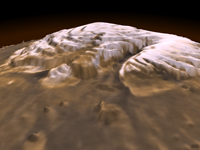
frozen carbon dioxide and water
Image courtesy of NASA Jet
Propulsion Laboratory
Mars has frozen carbon dioxide (CO2 ice) in the polar caps and absorbed into the ground, which would be released if the planet were warmed. This would thicken the atmosphere, and also further warm up the planet. The warming would also cause the frozen water that has been detected at the polar caps to melt. So Mars does seem to have the two key ingredients needed to sustain life. Not only that, but once Mars were initially warmed by some method, there would be a positive feedback in the release of carbon dioxide from the polar caps and regolith, the thickening of the atmosphere, the further warming of the planet, the release of water, and the consequent conditions that allow liquid water to persist on the surface.
How could we warm Mars or force the frozen carbon dioxide to be released into the atmosphere? Many ideas have been proposed, such as: putting mirrors in orbit around Mars to reflect extra light onto the Martian surface, thus warming it up; sprinkling dark dust on the poles to decrease their albedo (i.e. brightness) so that more of the Sun’s energy is absorbed; and releasing super-greenhouse gases into the atmosphere to warm up the planet. There are groups working on making the first two of these ideas technologically feasible. But we have already implemented the greenhouse gas idea on Earth – making it, at least for now, the most promising terraforming method.
Super-greenhouse gases are molecules which are very effective at absorbing energy released by the surface of the planet, and then re-radiating this energy both upwards into space – to be lost forever – but also downwards towards the surface of the planet, thus further heating it. They work in a similar way to a blanket. But we don’t want just any blanket! For example, carbon dioxide would be like a thin sheet whereas a super-greenhouse gas, like perfluoropropane (C3F8), would be like a thick wool blanket. So we would want to use super-greenhouse gases – with high warming potentials, and also long atmospheric lifetimes (1000s to 10 000s of years) – to reduce the required replenishment rate. A final key aspect is to choose super-greenhouse gases that do not destroy Mars’ natural current – and future – ozone layer (unlike chlorofluorocarbons, or CFCs).
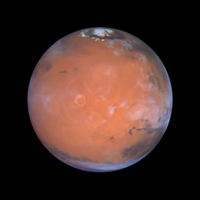
Image courtesy of NASA Glenn
Research Center (NASA-GRC)
Detailed atmospheric models show that one of the best super-greenhouse gases to use is perfluoropropane, and the total amount needed is about 26 000 times the amount of similar gases (CFCs, perfluorocarbons and hydrofluorocarbons) released on Earth by industry every year. This means that we cannot produce the gases on Earth and then ship them to Mars. Instead, the gases will have to be made on Mars. Consequently, terraforming Mars would likely commence when we start colonising Mars and there is both the incentive and the industrial power to create the factories necessary for producing the super-greenhouse gases.
Greenhouse gases are currently drastically – and undesirably – changing the Earth, so using them on Mars may seem irresponsible or just wrong. However, changing the climate on Earth is undesirable because there is already a highly evolved ecosystem that is intimately tied to the climate. But on Mars there is no such ecosystem: chemical and photographic investigations have shown that life is not proliferated and does not control its environment. There may still be dormant organisms, or organisms living underground. As good explorers and scientists, and in compliance with the planetary protection treaty, we should thoroughly explore Mars for extant life before contaminating our science investigations with Earth organisms or causing a competition between Earth and Mars life.
Fortuitously, the first stages of terraforming are expected to revert Mars to the way it was in its early history – when life would have started – thus giving any dormant or struggling survivors a chance to come out of hibernation and recreate a biosphere.
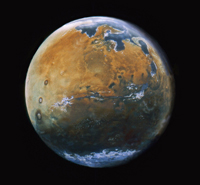
erraformed Mars
Image courtesy of Michael Carroll
/ stock-space-images.com
A discussion of terraforming would be incomplete without asking the question ‘Should we?’. Just because terraforming is technologically feasible and would not directly destroy an ecosystem does not necessarily mean that we should do it. Mars is beautiful and interesting the way it is, and perhaps we should leave it this way to allow its study by future generations as well as to preserve its current beauty. I would argue that life is the most valuable and beautiful thing we know, and spreading it throughout our Solar System and beyond is the most important thing we could do! It is the presence of life that makes Earth unique, and it is this presence of life that allows our own existence.
The terraforming of Mars would also allow us to more easily colonise and explore the planet, requiring us only to wear oxygen masks but no space suits in the higher pressure atmosphere.
One hundred years ago, astronomers thought they saw water and vegetation on Mars. They were wrong at the time, but maybe they were just seeing the future.
Review
A key feature of good science-fiction writing is that no matter how fanciful the idea, it must be theoretically feasible, such that at some future date the onward march of technology turns futuristic fiction to everyday fact. Margarita Marinova of Caltech details the feasibility of the sci-fi-sounding prospect of terraforming Mars – making conditions on the Red Planet more similar to our blue one, in the hope of sustaining (human) life.
Most students have an inherent interest in astronomical matters as well as in environmental issues, and the article neatly straddles both domains, incorporating aspects of the three traditional strands of science, together with geology. There is also scope for the ethics of terraforming to be covered in personal, social and health education (PSHE) lessons. Alternatively, artists could create illustrations of what a recently greened Red Planet could look like, and perhaps see how these compare with illustrations produced in the middle of the last century.
The article lends itself to use as a comprehension exercise or as a stimulus for class debate, where a variety of questions can be devised which cut right across the traditional science subdivisions. Comprehension questions could include:
- Find where ‘positive feedback’ is mentioned in the article. Explain what this means in the context of the article. Find another example of positive feedback (not in the article). Is the outcome of positive feedback always good?
- Which three methods of heating the Red Planet are mentioned? What are the possible pros and cons of each?
- How would human timescales change if we lived on Mars? How would day and night lengths compare? Would we still have seasons? How long would a year be? How does gravity’s strength compare between Earth and Mars, and would this have any effect on Martian sport, for example?
You could also wander into the realm of moral rights and wrongs of carrying out this planetary makeover. The big question of ‘should we?’ should generate a lot of discussion, and students could be asked to consider if their response to the question could depend on circumstances. For example, would it still be morally wrong to terraform Mars if life on our home planet was in terminal decline, and there was nowhere else for the human species to go? As mentioned above, this could form part of an ethics debate in PSHE lessons, and a larger scale example than the standard ‘right to life’ debate that tends to be used when science and ethics domains meet.
As well as a good introduction to the topic, this article is a useful starting point for further research should the idea stimulate students’ interest. They may want to watch clips of An Inconvenient Truth, in which Al Gore discusses greenhouse gases, and suggest how there could be a silver lining after all, in the global climate change cloud. Or they could investigate Mars further: how do we know what we know about Mars, given that no human has ever visited it? What plans currently exist to send people to Mars? What are the challenges of such a mission, and how do they compare with the challenge faced in the 1960s and 1970s to send men to the Moon? Finally, students could be asked to find examples of historical science fictions that have already become science fact.
Ian Francis, UK