Issue 9
Thu, 2008-10-02 16:15 — sis
Editorial
- Welcome to the ninth issue of Science in School
“Before I start, I’d like to mention two things: half of what I’m telling you will be wrong; and I don’t even know which half.” This introduction by renowned molecular biologist Ueli Schibler to his students illustrates a discomforting aspect of science....
Read (English, Russian) | PDF [2.5 MB]
Events
- Forthcoming events
Read (frequently updated) | PDF [132 KB]
Feature article: Steve Jones
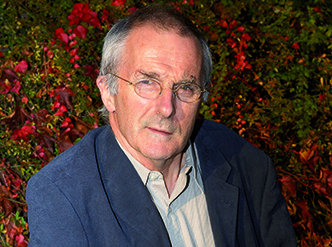
- Interview with Steve Jones: the threat of creationism
Steve Jones talks to Vienna Leigh about the startling re-emergence of creationism in Europe, how teachers can help, and why he will never argue with a creationist.
Read (English, French, German, Greek, Italian, Portuguese) | PDF [464 KB]
Cutting-edge science
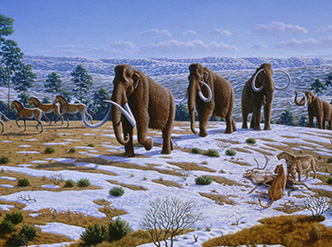
- What killed the woolly mammoth?
Climate change is nothing new. Caitlin Sedwick describes how a computer model is helping scientists to explain the extinction of the woolly mammoth.
Read (English, German, Greek, Italian, Polish, Portuguese, Romanian, Turkish) | PDF [236 KB]
Teaching activities
- Detecting sugar: an everyday problem when facing diabetes
Fred Engelbrecht and Thomas Wendt from the ExploHeidelberg Teaching Lab describe some experiments on sugar detection to demonstrate the problems that people with diabetes face every day.
Read (English, Bulgarian, French, German, Polish, Portuguese, Serbian, Spanish) | PDF [228 KB]
- Climate change modelling in the classroom
Why not get your students to make their own predictions of climate change – with the help of Dudley Shallcross and Tim Harrison from Bristol University, UK?
Read (English, Dutch, French, German, Italian, Polish) | PDF [288 KB]
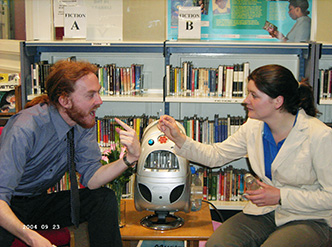
- Meet the Gene Machine: stimulating bioethical discussions at school
Laura Strieth, Karen Bultitude, Frank Burnet and Clare Wilkinson use drama and debate to encourage young people to discuss genetics and what it means for us all. Why not join in?
Read (English, Croatian, Dutch, German) | PDF [312 KB]
- Investigating the action of urease
Anna Lorenc from the Volvox project explains the importance of the enzyme urease and presents a protocol to demonstrate urease activity in the classroom.
Read (English, German, Portuguese, Spanish, Turkish) | PDF [1.8 MB]
Projects in science education
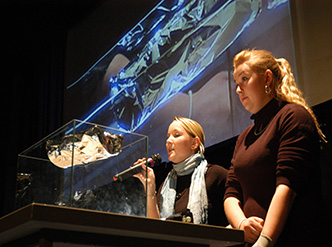
- Fun physics in school: students perform for students
Herbi Dreiner and Tobias Strehlau describe how a university physics show inspired a secondary-school teacher and his students to perform their own school physics show. Why not try it in your school?
Read (English, German, Greek, Polish, Portuguese, Romanian) | PDF [208 KB]
- Is there anybody out there? An ark of life
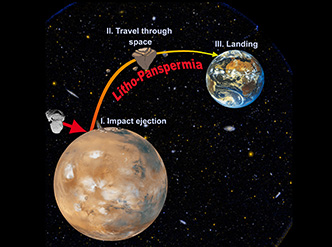
An enormous meteorite impact and then a rocky flight from Mars. Is that how life appeared on Earth? Cornelia Meyer takes us on a space trip through the lithopanspermia theory and describes how she is putting it to the test with the help of student colleagues.
Read (English, German, Italian, Polish, Portuguese, Romanian, Spanish) | PDF [452 KB]
Science topics
- Materials science to the rescue: easily removable chewing gum
Halina Stanley investigates the history of chewing gum, how the chemistry of the gum affects its properties, and how scientists are using this knowledge to make chewing gum less of a pollutant.
Read (English, German, Greek, Spanish, Turkish) | PDF [304 KB]
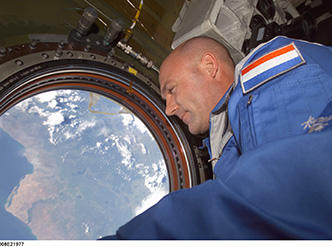
- The International Space Station: a foothold in space
In the first of two articles, Shamim Hartevelt-Velani and Carl Walker from the European Space Agency take us on a trip to the International Space Station.
Read (English, Bulgarian, German, Italian, Polish, Spanish) | PDF [192 KB]
Scientist profile
- Cornelius Gross: from the classroom to the laboratory
The majority of young scientists working in research have only ever been that – scientists. But Vienna Leigh reports how one scientist started his career at the front of a classroom – and feels that his science benefits as a result.
Read (English, German, Italian, Turkish) | PDF [180 KB]
Teacher profile
- Curiosity killed the cat – or did it?
Frode Skjold tells Sai Pathmanathan about some of his favourite activities to teach science in primary school.
Read (English, Russian) | PDF [244 KB]
Reviews
Return to top of page
Print journal
Subscribe to the print journal here
|