


How I killed Pluto: Mike Brown Understand article
To change the world would be amazing enough. Mike Brown changed the Solar System. Eleanor Hayes explains.

© Calvin J Hamilton
(www.solarviews.com)
Until 2006, most non-astronomers probably thought that these days, the Solar System was unchanging and unchallenged. Until, that is, it was decided that Pluto was no longer a planet. Meet Mike Brown, who unintentionally sealed Pluto’s fate and triggered our new understanding of what is – and what is not – a planet.
The story began in the late 19th century, with the search for Planet X, the ninth planet in the Solar System. In 1846, astronomers had noticed that Uranus’s orbit around the Sun was being perturbed by something; this ‘something’ was found to be the massive gaseous planet Neptune. When it seemed (incorrectly) that the orbit of Neptune was itself being perturbed, astronomers hypothesised the existence of another massive planet, even further from the Sun: Planet X.
For such a huge planet, Planet X proved remarkably difficult to find. When Clyde Tombaugh finally discovered it in 1930, it became clear why. Named Pluto, at the suggestion of an 11-year-old schoolgirl, the newly discovered planet was tiny, with a diameter only three-quarters that of our Moon. As Mike Brown, professor of planetary astronomy at California Institute of Technology (Caltech)w1, USA, says, “Most people seem to think Pluto is a fairly major body in the Solar System – it’s often depicted about the same size as Mercury. But that’s so wrong!”

© Calvin J Hamilton (www.solarviews.com)
Although in 1930, Pluto was thought to be somewhat larger and more massive than it actually is, even then, astronomers recognised that its orbit was odd. The other planets travel around the Sun on circular orbits, their orbits forming a flat disc. Pluto’s orbit, in contrast, is elongated and tilted at about 20° to the disc of the other planets’ orbits. From the time of its discovery, “Pluto was seen as the weird planet at the edge of the Solar System”, states Mike.

© Calvin J Hamilton
(www.solarviews.com)
Some 60 years later, though, “Pluto suddenly started to make sense, because with the development of digital cameras and bigger telescopes, astronomers got better at finding objects in the outer part of the Solar System, beyond Neptune.” The first of these objects was found in 1992, and within a decade there were 500 of them – all discovered in the same way that Clyde Tombaugh used to find Pluto – taking repeated pictures and looking for movement. This band of objects beyond Neptune is what is now known as the Kuiper Belt. All had orbits similar to Pluto’s – elongated and tilted – and although in 2002, Pluto was still far larger than any of these objects, “it was clear that Pluto was part of the Kuiper Belt rather than part of the planetary system, but many people were desperate to keep calling it a planet.”
Pluto might have remained a planet, if it weren’t for a frustratingly cloudy night in December 1999. Unable to use the telescope, Mike claimed to a colleague, “I think there’s another planet out there, beyond Pluto.” He pointed out that the small objects in the Kuiper Belt were being discovered with very small, targeted searches. If only astronomers could work out how to look at the whole sky, he believed that they were bound to find something larger than Pluto.
“I bet her that within five years, someone would find a planet beyond Neptune. I was convinced that someone was going to find it, but mostly, I was convinced it was going to be me!”
Determined to win his bet, Mike set about devising the best combination of telescope and camera to monitor the whole sky. “Astronomers had actually got a lot worse at covering large patches of sky over the previous 50-60 years. Clyde Tombaugh used photographic plates attached to the telescope but by the late 1990s, astronomers were using digital cameras. They were more sensitive but not good at seeing large swathes of sky.”
One digital camera may not have covered much sky, but 112 digital cameras stuck together gave Mike the biggest digital camera in the world at that time. He attached it to the wide-field telescope at Caltech’s Palomar Observatory in California, and – via a microwave link – could operate it robotically from his computer. That cable is one of Mike’s favourite pieces of equipment. “In the ten years that I worked on this telescope nearly every single night, I never had to go to Palomar – a three hour journey from my home. Instead, I could do things that normal people do like getting married and having a kid.”
Night after night, Mike and his colleagues Chad Trujillo and David Rabinowitz would point the telescope at a little patch of the sky and take three pictures over the course of three hours. A bank of computers would then compare the images, to identify anything that was moving. “The computer is OK, but your eye is better at filtering out noise – little blips that the camera produces. Every morning, the computer would have picked out one or two hundred potential moving things, and I would flip through the images, searching for any that really moved.”
“You can tell a lot about an object from these images. Everything in the Solar System is moving – so you can tell that it’s in the Solar System by the fact that it moves, but you can also tell how far away it is by how fast it moves. The closest things to us move the fastest. You can also tell about how big it is by how bright it is. These objects don’t have any of their own light; they only shine by reflected sunlight so to reflect more sunlight, they have to be bigger.”
“It’s exciting to go to work each morning thinking ‘this morning, you might see something moving across the sky, and you will be the first human to have ever seen it.’ It made walking into the office, sitting down and looking through those hundred things the best part of my day.”
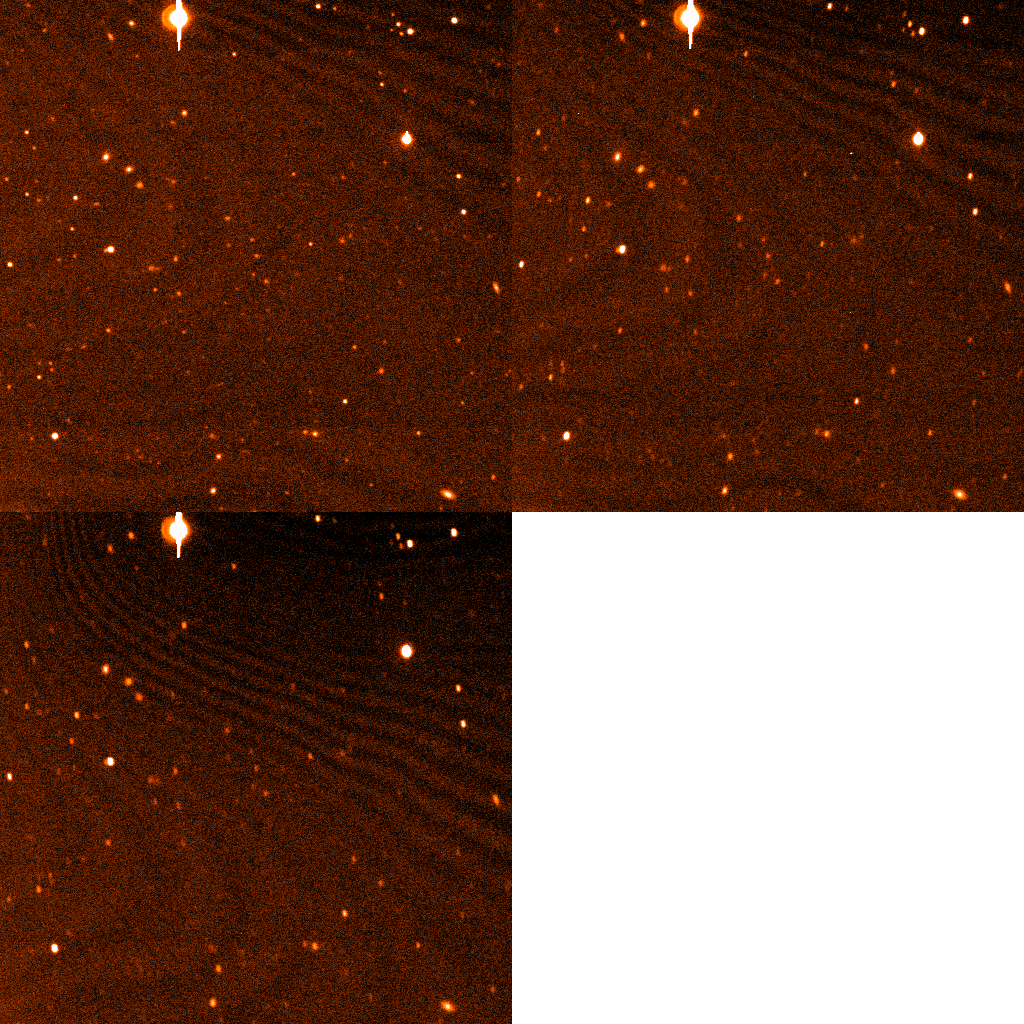
Brown to discover a new
potential planet.
Click on image to open the
moving version of the image
Image courtesy of Mike Brown
“So you will understand my reaction when, on 5 January 2005, I was flipping through the images and I came to this one.” Unlike 60 or so previous objects that Mike and his colleagues had found, it was moving very slowly, which meant it was a long way away. “It was well beyond the Kuiper Belt, more distant than anything we had ever seen before, and it was also the brightest thing we had ever discovered. This combination told us immediately that this thing had to be really, really, big.”
“We knew it was at least the size of Pluto and, if you remember the bet that I made back in December 1999, that was our criterion for a planet. So I had won the bet, except it was 5 January 2005 and the bet expired on 31 December 2004. Fortunately, my friend kindly gave me a five-day extension.”
What about its orbit? Did the object have a circular orbit like the massive planets do? Or did it have an elongated and tilted orbit like Pluto and the objects in the Kuiper Belt? Fortunately, over the decades, astronomers had taken many pictures of the sky. By sifting through this data back to 1950, Mike Brown and his colleagues were able to establish the orbit: even more elongated than that of tiny Pluto, and tilted at 45° to the orbits of the eight massive planets of the Solar System.
They then returned to the question of size. The fact that it was bright – reflecting a lot of sunlight – suggested it was big. “But you can reflect a lot of sunlight in two very different ways: you can be a massive body covered in dirt, or you can be smaller and covered in snow or frost, and you’ll reflect the same amount of sunlight.” To determine which was the case, Mike and his colleagues used the Hubble Space Telescope. The results were a big surprise: their newly discovered object was only about the same size as Pluto. How then, could it be so bright?

Image courtesy of NASA / JPL-Caltech
They realised it was probably a question of the atmosphere. “Pluto has an atmosphere when it is closest to the Sun; our object probably would have too but it is so far from the Sun right now that the atmosphere is frozen on the surface. We thought the atmosphere was probably nitrogen, like Pluto’s atmosphere and our atmosphere, and it is frozen in a thin layer, making the object incredibly reflective. The same thing would happen to Earth, if you moved it that far from the Sun – only we’d have layer of nitrogen ice 10 metres thick, instead of 0.5 millimetres.”
So what was the significance of the discovery of this ‘new’ object? In a sense, says Mike, nothing. “It’s still exactly the same Solar System, just with a little bit of noise at the edge.” But it brought the debate about Pluto to a head: if the newly discovered object was classed as a planet, where do you draw the line?
After lengthy and agitated discussions, on 24 August 2006, the International Astronomical Union (IAU) decided to return the number of planets to eight: Mercury, Venus, Earth, Mars, Jupiter, Saturn, Uranus and Neptune. Pluto, Ceres (previously known as an asteroid) and the newly discovered object were reclassified as dwarf planets (see box).

The image of Pluto was rendered from a map created from a series of Hubble images. The image of 2003 UB313 is an artist’s impression and the image of Ceres is from the Hubble Space Telescope
© Calvin J Hamilton (www.solarviews.com)

the new dwarf planet
Image courtesy of ESO /
L Calçada
Mike believes the decision was the right one – and he’s not even too disappointed about the loss of his planet. “My original goal in 1999 had been to find the tenth planet, but I think having forced the world into a new appreciation of the Solar System is even better. The Solar System is a beautiful and profound place, and it is made richer by the realisation that the eight planets are the foundation throughout which countless smaller bodies continuously swirl.”
Another consequence of the final classification was that Mike and his colleagues finally got to name the object they had found. Appropriately, “we called it Eris, after the Greek goddess of discord and strife.”
The story continues
Even today, the story is not complete. Until early 2011, explains Mike, “I would have said the composition of Eris was more or less like that of Pluto, with a core of rock and a big mantle of ice on the outside. Sort of like Earth, which has an iron core and a rocky mantle.” Recent researchw2 (Sicardy et al., 2011), however, has made astronomers revise their view. They now know that although Eris is small – about the same size as Pluto – it is 27% more massive. How do they explain this? “Pluto and Eris are much more different than I would have guessed. Eris is almost entirely rock, with only a thin layer of water ice around it. And on the very outside, like the water on Earth, it has frozen gases – methane, and probably nitrogen and carbon dioxide.”
Reclassifying the Solar System
On 24 August 2006 in Prague, Czech Republic, the general assembly of the IAU resolved that that planets and other bodies in our Solar System, except satellites, should be defined into three distinct categories.
- A planet is a celestial body that (a) is in orbit around the Sun, (b) has sufficient mass for its self-gravity to overcome rigid-body forces so that it assumes a hydrostatic equilibrium (nearly round) shape, and (c) has cleared the neighbourhood around its orbit.
- A dwarf planet is a celestial body that (a) is in orbit around the Sun, (b) has sufficient mass for its self-gravity to overcome rigid-body forces so that it assumes a hydrostatic equilibrium (nearly round) shape, (c) has not cleared the neighbourhood around its orbit, and (d) is not a satellite.
- All other objects, except satellites, orbiting the Sun shall be referred to collectively as small Solar-System bodies.
Acknowledgements
This article is based on a lecture given by Professor Brown, as part of the Silicon Valley astronomy lecturesw3, with permission of Professor Brown and the Astronomical Society of the Pacific.
References
- Sicardy B (2011) A Pluto-like radius and a high albedo for the dwarf planet Eris from an occultation. Nature 478: 493-496: doi: 10.1038/nature10550
- Download the article free of charge here, or subscribe to Nature today: www.nature.com/subscribe
Web References
- w1 – To learn more about Mike Brown’s work, visit his university web page: www.gps.caltech.edu/~mbrown
- w2 – To learn more about the recent measurements made of Eris, see the ESO press release: www.eso.org/public/news/eso1142
- w3 – Mike Brown’s lecture and many others in the Silicon Valley astronomy lecture series can be listened to, downloaded or subscribed to as podcasts via the website of the Astronomical Society of the Pacific: www.astrosociety.org/education/podcast
Resources
- The full story of Mike Brown’s involvement in the demise of Pluto can be found in his book:
- Brown M (2010) How I Killed Pluto and Why it Had it Coming. New York, NY, USA: Spiegel & Grau. ISBN: 978-0385531085
- You’re unlikely to find a new planet yourself, but to learn how to detect asteroids in the classroom, see:
- Newsam A, Leigh C (2011) Hunting for asteroids. Science in School 20: 30-35. scienceinschool.org/2011/issue20/asteroids
Review
The story describes the work of Professor Mike Brown, his hunt for the tenth planet in our Solar System – and the unexpected result. It is based on a lecture given by Professor Brown, so the style is pleasant, like an exciting adventure story.
The article could be useful in physics, astrophysics or geography lessons, but also in language, biology or even history lessons. Each teacher can find a way to use the article to raise interest in science – even those teachers without much knowledge of physics.
Gerd Vogt, Higher Secondary School for Environment and Economics, Yspertal, Austria