


Solar cars: the future of road transport? Understand article
Ever dreamed of a car that needed no fuel and produced no pollution? Mico Tatalovic investigates the solar car.

of southern China
Image courtesy of Louis
Palmer and solartaxi.com
“I would like to tell you something about the first tour ever of a vehicle that drove around the world without petroleum-based fuel: it was a solar car,” says Louis Palmer, a Swiss mathematics teacher who travelled around the world in a solar car. He did it to make a point: at least in theory, all the energy necessary for powering cars could be derived directly from the Sun – with no need for polluting petroleum.
The chic, blue Solartaxi got most of its energy from the solar panels on its trailer. On a cloudy day, Palmer re-charged the car from the electricity grid, but he made sure that it was clean solar electricity by installing solar panels on his house and feeding the electricity produced into the grid. He claims that electric car technology is viable, and solar panels can fuel all of our road travel. “Sunshine is free,” he says.

Solartaxi in Monument Valley,
Arizona, USA
Image courtesy of Louis Palmer
and solartaxi.com
Palmer says that he had wanted to do a road trip around the planet to “see the beauty of this world” since he was eleven, back in 1982. But his teacher warned him that such a trip would damage the planet – polluting gases from the exhaust pipe would contribute to the growing pollution and global warming of the very planet he was so eager to get to know better. By the time he was 14, Palmer made plans for an eco-friendly solar car; he figured that in 20 years time, everyone would be travelling in solar-powered electric cars anyway. With all the problems that petroleum-fuelled cars caused, such as global warming, polluted air and oil-based conflicts, he thought that electric solar cars would soon replace them.
Some 20 years later, in 2004, Palmer decided: “OK, if I cannot buy a solar car, I will build it myself. But then I realised I had no idea how to build a car and no money to do it.” These two problems might have discouraged a less optimistic person, but not Palmer: “I thought that if it was a good idea, I would get support.” And indeed he did: more than 200 friendly individuals and several corporations helped him make a car that would take him across 38 countries in 18 months, without emitting any carbon dioxide and using only clean solar energy.
Of course, building the car and its solar panels requires energy and causes carbon dioxide emissions, but once built, Palmer’s Solartaxi did not emit any carbon dioxide. He believes, therefore, that solar cars have an important role to play in slowing global warming. Furthermore, three years after his world tour in 2007, Palmer is still using the Solartaxi as his personal vehicle, driving on the same batteries, paying nothing for fuel and spending nothing on repairs (there have been none).

Racing car
Image courtesy of Cambridge
University Eco Racing
To design and construct the Solartaxi, Palmer had the help of students from four Swiss universities. Similar student efforts have helped build many different solar racecars for the World Solar Challengew1 since 1987. More than 40 universities have solar car teams that compete at this biennial event in Australia. The 2007 winners averaged speeds of more than 90 km/h, were powered solely by the Sun, and covered 3021 km from Darwin to Adelaide.
Similar races take place elsewhere, such as the American Solar Challengew2 (Plano in Texas, USA, to Calgary, Canada, biennially since 2001) or the South African Solar Challengew3 (from Johannesburg to Pretoria via Cape Town and Durban, since 2008). But with some of the brightest young engineers working on designing solar cars for more than 20 years now, an obvious question springs to mind: Why aren’t we seeing more of these cars available for purchase at our local car dealerships?
David Sims-Williams, an engineer from the University of Durham, UK, and a technical advisor to Durham University’s solar car team, another undergraduate team of solar racecar engineers, says that solar racecars “are not intended to be prototypes of future road vehicles”. For the small solar panels on their roofs to be enough to power them, solar cars have to be extremely light and aerodynamic. As a result, most solar racecars are single-seaters, looking more like space rockets than normal cars – they are built to win races, not to accommodate families on their shopping trips. Although they do not translate directly into commercial cars because their purpose is so different, they are still important in raising public awareness of this technology.

Racing car
Image courtesy of Cambridge
University Eco Racing
At the moment, it would be very difficult to power large, heavy cars purely with solar panels on their roofs. The solar panels that racecars use are expensive and easily damaged, so most commercial solar cars have thus far used less efficient (but cheaper and less sensitive) solar panels that can only partially power them, for example by supplying just the energy to run the car’s air conditioning, such as in Toyota’s Solar Prius or Pininfarina’s BlueCar.
Nonetheless, says Sims-Williams, the technology developed for solar racecars will find its way into mainstream motoring eventually, as big car manufacturers pick up on technological advances made by the specialised race teams, and start implementing them in commercial cars, usually with a lag of about 10 years.
Everyone Palmer talked to in every corner of the globe would love to buy a completely solar car, but “to bring this technology to the mainstream market, the cost of straightforward, non-solar electric cars has to come down,” he says. This would require more investment in the mass production of electric cars to overcome some of the associated problems. Like all electric cars, solar cars need an electric battery, which has a limited range, especially when the Sun isn’t shining. So far, these batteries have been rather heavy and expensive to fit into cars – a limitation that has turned buyers away from electric (and thus solar) cars in the past.
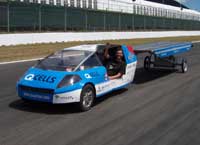
on Taupo Racetrack in New
Zealand
Image courtesy of Louis
Palmer and solartaxi.com
So far, although a few solar cars such as Palmer’s Solartaxi, the French company Venturi’s Astrolabw4 or the Australian UltraCommuterw5 exist, the vast majority of cars in use today are not solar or even electric. Commercialising the solar car technology is still in its infancy. So will the solar electric car technology ever revolutionise the way we drive? Palmer says this is up to us. For him, it already has.
As we speak, Palmer’s next quest is to organise an electric car race – the Zero Emissions Racew6 – in which international teams of engineers will design cars dependent on renewable energy and capable of racing at fast speeds, again to raise awareness of electric cars’ capability. As we go to press, the race is planned to start on 15 August 2010 and will go around the world in 80 days, returning to its starting point in Geneva, Switzerland.
Web References
- w1 – To find out more about the World Solar Challenge in Australia, now the Global Green Challenge, see: www.globalgreenchallenge.com.au
- w2 – Learn more about the American Solar Challenge here: http://americansolarchallenge.org
- w3 – For more information about the South African Solar Challenge, see: www.solarchallenge.org.za
- w4 – The French automobile manufacturer Venturi built the electro-solar hybrid concept car Astrolab. See: www.venturi.fr/electric-vehicules-astrolab-concept.html
- w5 – Find out more about the Australian car manufacturer HybridAuto’s Ultracommuter here: www.hybridauto.com.au
- w6 – Learn more about the Zero Emissions Race here: www.zero-race.com
- w7 – Bluesci is a student-run science magazine at Cambridge University. See: www.bluesci.org
- w8 – To learn more about SciDev.Net, see: www.scidev.net
Resources
- The Suntrek website enables you to ’take a journey into space and find out more about the Sun and its effect on the Earth’, including a range of school activities and projects. See: www.suntrek.org
- ‘Formula Sun’ is a project for UK secondary-school students to build solar boats and race them in a national challenge, delivered by the ‘Engineering your future’ initiatives. See: www.engineeringyourfuture.com
- Solar-Active offers educational resources, workshops and courses in sustainable development, energy efficiency and renewable energy technologies, including solar power. See: www.solar-active.com
Review
Renewable energy is an important topic, discussed in all European countries; students hear about it not only at school but also in the media. The topic is an exciting one for young people, and this article could be used for all topics involving energy – not only physics but also in interdisciplinary discussions (e.g. physics, chemistry and social studies). Since the author highlights how it is possible to build and use solar cars, the students could discuss the problem of storing energy for night or cloudy days.
Alessandro Iscra, Italy