


Sentinels: meerkat superheroes Understand article
Mico Tatalovic from the University of Cambridge, UK, investigates the private lives of meerkats. Why do these small carnivores live in groups? Why do they feed each other’s pups, dig together and guard each other? And what makes a really good sentinel?

Image courtesy of Mico Tatalovic
Flower is an internationally acclaimed television star. The Discovery Channel’s series Meerkat Manor, the first ‘animal Big Brother’ show, made her cute little face popular around the globe. Now a feature-length biography has also been released with an accompanying book, Meerkat Manor: The Story of Flower of the Kalahari.
Flower’s story only reached the world because of the research efforts of scientists based at the University of Cambridge, UK, who set up the Kalahari Meerkat Projectw1 15 years ago and have studied the lives of several meerkat groups daily ever since. Such long-term field projects have become popular in the field of behavioural biology because they permit the accumulation of an enormous amount of data on every aspect of animals’ lives, allowing scientists to ask and answer ever-more detailed questions about their evolution.
When not on camera, Flower, like other meerkats (Suricata suricatta), has to worry about two main things in life: finding food, and avoiding being eaten herself. When the right time (and the right male) comes, a third worry comes into her head: reproducing. Such is the nature of natural selection: only those who survive long enough to reproduce will spread their genes to the next generation. Flower is a descendent of a long line of survivors. This means she has adaptations that allow her to survive despite the many predatory species out to get her.
Birds of prey, wild cats, jackals, snakes…. If it’s bigger than a meerkat and it eats meat, it’s probably a threat. Living in a group is an advantage; many eyes see better. But meerkats have evolved an even more sophisticated strategy to avoid predation: posting sentinelsw2, usually one but sometimes several at the time. Like soldiers on guard, meerkat sentinels scan the horizon from an elevated post and announce their duty with a special sentinel call, the ‘watchman’s song’. They have excellent depth perception that allows them to see predators at a great distance. Having a sentinel on guard reduces the possibility of surprise attacks and allows the rest of the group to be less vigilant.
Sentinel behaviour may seem altruistic since the sentinels help others at their own expense: when they are guarding, they not only expend energy and lose valuable foraging time, but also expose themselves to predators. But are they really being altruistic?

of a dry branch
Image courtesy of Eleanor Harris
My research group investigates conflicts and co-operation in meerkat societies, and as part of this work, I focus on sentinels. One of the main questions I am investigating is why some meerkats spend more time on guard than others. An answer to a simple question like this can give us valuable insights into the evolution of social behaviour. ‘Why are some humans more social than others?’ and ‘How did our sense of community and helping others initially evolve?’ we may ask eventually. Until then, we study model animals, such as meerkats, to give us preliminary answers and to help us formulate and test theories
Flower keeps guard from trees, logs, bushes, grass tufts or even human heads. The average height of the posts from which meerkats keep guard is around 60 cm although the bravest sentinels will climb trees up to six metres high. The height of the sentinel’s post also varies with the vegetation cover; during the rainy season when grass is tall, sentinels guard from higher posts so that they can see above the grass. This reflects the fact that the behaviour of wild animals is affected by their environment; when studying behaviour, it is often important to consider the environmental effects.
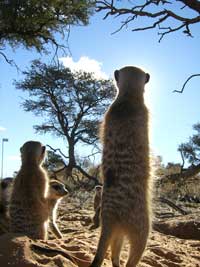
Especially in winter months,
meerkats sun themselves to
warm up in the morning before
foraging, and in the evening
before going to sleep
Image courtesy of Mico Tatalovic
Sentinel behaviour also differs between individual meerkats. Some sentinels will go on guard more often, and guard longer and from higher posts: this is why we consider them to be ‘supersentinels’ – although we don’t actually know if these individuals are also the most efficient in detecting predators. The longer they stay on guard, the more likely they are to announce their alertness when protecting the group, so that the group can relax. Supersentinels are also likely to be animals that are usually more vigilant; even when they are not on sentinel duty, they often stop while foraging for food to briefly check the surroundings for anything suspicious. It seems that these supersentinels also have higher levels of the stress hormone cortisol. This raises the question of whether this hormone is the cause or the effect of their behaviour. Future research could address this by observing how an increase or decrease in cortisol levels – by introducing the hormone into the animal’s system or blocking it through the introduction of another molecule – changes meerkats’ behaviour.
But why do we devote so much time to elucidating meerkat behaviour? Studying specific behaviours such as guarding is like fitting a single piece of puzzle into the larger picture of the evolution of social behaviour. Eventually we would like to understand how, why and when co-operation evolved in animals and in our own species. We would like to know why we are so different from other animals. We would like to probe deeper into the evolution of life on our planet and to satisfy our thirsty curiosity. “Why?” It’s the question that drives science.
Meerkats are an excellent model system to test hypotheses arising from the theory of evolution. One of the biggest unsolved problems in evolutionary biology is the existence of altruistic behaviours in humans and animals. Darwin’s theory of natural selection argues for the survival of the fittest through competition for limited resources (food, mates, space). Yet, we find animals such as meerkats co-operating happily; they baby-sit and feed (even lactate for) other meerkat’s pups, dig burrows together and guard the whole group from predator attacks. How can Darwin’s theory explain the observed harmonious lives of meerkats?
After 15 years of detailed study of meerkats, Professor Tim Clutton-Brockw3 of Cambridge University and his colleagues say that meerkats are not that altruistic after all. There is a lot of selfish behaviour going on. A classic example, published in the journal Science, is the finding that meerkat sentinels guard from safe sites, and only once their bellies are full (Clutton-Brock et al, 1999). Moreover, being the first to spot predators means that in most cases they are the first to escape them too. This suggests that direct, selfish benefits are the main causes of the evolution of this social, apparently altruistic behaviour. However, we still don’t know exactly why meerkats guard and why some are just so super at it. The current hypothesis is that good foragers – meerkats that are the most efficient at capturing prey – are also the best sentinels, because they spend less time foraging and thus have more time and energy to spend on other activities. But the evidence is still too scarce to support this. My research might help elucidate some of the answers to these questions. I just hope they’re not doing it only for the cameras!
Meerkat society
Meerkats (Suricata suricatta) are small, carnivorous mammals weighing on average less than one kilogram. They inhabit the arid areas of southern Africa and live in social groups of 2-50 individuals, consisting of one dominant pair and a variable number of subordinate helpers who may or may not be related to the dominant pair. These members of the mongoose family (Herpestidae) eat mainly arthropods (insects, spiders and their relatives), as well as the occasional small mammal, reptile or plant bulb.

Sleeping burrows may have
several exits and rooms inside.
Meerkats maintain them but
don’t dig them; instead they use
ground squirrels’ burrows and
sometimes also share them with
yellow mongooses that live in
small family groups
Image courtesy of Mico Tatalovic
They have territories with several sleeping burrows, from which they make daily foraging trips of up to a few kilometres. Depending on food availability and predation pressure at specific spots, they will either return to the same sleeping burrow for several nights, or change burrows quite frequently.
On average, litters consist of three to four pups that stay within the burrow until they are approximately three weeks old. During that time, while the pups are being fed on milk, the group returns to the same burrow. At four weeks of age, the pups begin travelling with the group and, for the first three months of their lives, are fed on invertebrates and small vertebrates are by helpers.
Meerkats reach adulthood at around one year of age. At around 18-30 months of age, males voluntarily leave the group, either to join an existing group or to form a new group with unrelated females. Adult females, particularly pregnant ones, may be evicted from their home group by the pregnant dominant female; this is thought to reduce the chance of the dominant female’s pups being eaten by the other females. Most females return to the group once the dominant female has given birth, but some may permanently disperse to form new groups with unrelated males.
Dominant meerkats live for 6-10 years on average, with the oldest individual in the Kalahari Meerkat Project being almost 13 years. The age of subordinate meerkats is more difficult to record, as many disperse or are evicted by the age of around three years, and are subsequently lost to the project records. The most important known causes of death are predation, fights with other meerkats (including infanticide), diseases and human-caused factors such as car fatalities – but for two-thirds of the Kalahari Meerkat Project meerkats, the cause of death is unknown, since the individuals just disappeared.
Meerkats are an excellent model species for studying behavioural biology and ecology because they can be habituated to close observation by humans; they are also diurnal and forage in a relatively open habitat and are hence easy to follow and observe on foot. The aspect of their lives that interests evolutionary biologists the most is their sociality. Why do they live in groups? Why do the young adults stay in the group and why do they help each other? What are the evolutionary conflicts among individuals living in groups and how are these resolved?
Benefits of group living
For meerkats, group living makes sense because there is little available land for establishing their own territories, most of the appropriate habitat having already been taken by rival groups, and the harsh desert environment makes it difficult to survive alone.
All adult meerkats contribute to co-operative behaviours; the main ones are pup feeding, sentinel duty, burrow maintenance and, for females, allolactation (lactating for another meerkat’s pups). Co-operation increases the pups’ survival, development and subsequent reproductive success, which benefits the group as a whole, because larger groups are more likely to survive.
Costs of group living
There is a trade-off for individuals between the benefits and costs of group living. One of the main costs of group living is the prevention of reproduction: the dominant breeding pair accounts for around 80% of the offspring born to the group. Dominant females try to weight the reproduction in their own favour, so that they produce as many offspring as possible; subordinate females are commonly expelled from the group by the dominant female in the latter half of her pregnancy to prevent infanticide by subordinates. Subordinate females are also evolutionarily driven to reproduce, in spite of attempts by the dominant female to prevent this from happening. Similarly, subordinate males try to find receptive females from neighbouring groups and thus enhance their reproductive success.
The exact nature of these within- and between-group conflicts and resolutions is a subject of continuing research. Currently, scientists are looking at the way in which different hormones such as oxytocin (the ‘trust’ hormone) affect social behaviour and conflicts within the group. Others are examining the influence of an individual meerkat’s personality on its behaviour and decisions.
Meerkat research
The Kalahari Meerkat Project was set up some 15 years ago by Professor Clutton-Brock from the University of Cambridge, UK. Since then, the Cambridge scientists have collaborated with colleagues in other countries, especially at the University of Zurich in Switzerland and Pretoria University in South Africa.
All meerkats involved in the project are wild but habituated to people and are easily identifiable by small dye marks that the researchers and volunteers have painted on them. These dye marks make for easy identification, as ‘head and shoulders’ is different from ‘right rib, right thigh’. Familiar with people since birth, the animals ignore us so we can observe them from as little as 0.5 m away and walk among the group without disturbing their normal behaviour. Since most meerkats are studied from birth, each individual’s parentage and life history is recorded.
The project manager makes a weekly schedule of group visits to allow researchers (master’s students, PhD students and postdoctoral researchers) to visit the meerkat groups they need for their experiments and to make sure all groups are visited at least a couple of times a week by volunteers to keep track of where the animals go and what they do. In every group, one animal has a radio collar that allows it to be tracked; most of their sleeping burrows are also labelled with GPS points so it is easy to locate them. All pups are caught and an identity microchip is inserted under their skin in case the dye marks on their fur wear out. Blood samples are also taken at regular intervals throughout their lives, to obtain both their DNA and hormonal profiles. This helps researchers to determine relationships within and between the groups and to correlate behaviours with hormone levels. The animals are captured for only a few minutes, to avoid stressing them too much.
For the scientists, a typical day of meerkat research involves waking up before sunrise to arrive at the sleeping burrow before meerkats get up. Various records have to be kept, such as where the animals slept, when they got up, how heavy they are (we use small crumbs of hard-boiled egg to lure them onto scales, saying “yum, yum, yum!”). We also count and identify all the animals to check the group’s composition and then follow them for three hours while they forage for food and avoid predators. When following them, we also take regular GPS readings to calculate the routes that the meerkats take on their foraging trips. At midday, when the meerkats have a siesta to avoid the heat of the desert sun, we leave to have lunch and return in the afternoon for more data collection. Afternoon experiments might include playing the meerkats’ own vocalisations back to them or presenting them with predator cues or faeces to observe their responses.
References
- Clutton-Brock TH et al (1999) Selfish sentinels in cooperative mammals. Science 284: 1640-1644. doi: 10.1126/science.284.5420.1640
Web References
- w1 – For more information about the Kalahari Meerkat Project see: www.kalahari-meerkats.com
- w2 – To watch a video clip of meerkat sentinels on the Discovery Channel website, see http://animal.discovery.com/fansites/meerkat/video/video.html (note that you may have to watch an advertisement before the video clip appears)
- w3 – For more information about the work of Tim Clutton-Brock’s research group, see: www.zoo.cam.ac.uk/zoostaff/larg/Pages
Resources
- The Fellow Earthlings’ Wildlife Center, which specialises in caring for meerkats: www.fellowearthlings.org
- The East Coast Meerkat Society: www.meerkatsrule.org
Review
This article provides some basic information about meerkats and addresses various aspects of their social behaviour, with an emphasis on the sentinels. The article is interesting, sometimes even humorous, just like the animals it talks about. It makes good material for discussions/debates on issues such as the evolution of co-operation in animals and in humans, and how animal and human altruism compare and contrast. The issue of social behaviour also creates the opportunity for interdisciplinary studies.
The article could give rise to many comprehension questions, including:
- Why do researchers consider meerkats to be excellent model species for studying behavioural biology and ecology?
- What are the benefits and the costs of group living for meerkats?
- Why does Professor Tim Clutton-Brock say that meerkats are not altruistic?
- Which main co-operative behaviours do adult meerkats contribute to?
- How does the height of the sentinel’s post vary according to the environmental conditions present at the time?
- Why are meerkats considered an excellent study system to test hypotheses arising from the theory of evolution?
Michalis Hadjimarcou, Cyprus