
Fizzy fun: CO2 in primary school science
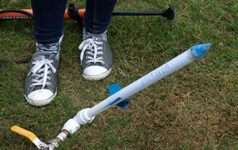
Marlene Rau presents some fizzy and fun activities involving carbon dioxide, developed by Chemol and Science on the Shelves.
Showing 10 results from a total of 326
Marlene Rau presents some fizzy and fun activities involving carbon dioxide, developed by Chemol and Science on the Shelves.
Keen to save the world? Andy Newsam and Chris Leigh from the UK’s National Schools’ Observatory introduce an activity where you can potentially do just that: by detecting real asteroids – which may be heading for Earth.
Roller coasters, carousels and other amusement park rides can be great fun – and can even be used as a science lesson, as Giovanni Pezzi explains.
Renewable energy is not only important in the developed world; in developing countries, it may be a prerequisite to overcoming poverty. Marlene Rau introduces a teaching activity from Practical Action.
What does it take to live on the Moon or even Mars? Erin Tranfield suggests an interdisciplinary teaching activity to get your students thinking about this – and learning a lot of science along the way.
With the help of a detective game, Kenneth Wallace-Müller from the Gene Jury team introduces the use of DNA in forensics and the ethical questions involved.
Did you know that the electron and electricity are named after amber, the ‘gold’ of the Baltic Sea? Bernhard Sturm’s teaching unit based on this fossilised resin introduces not only conductivity but also many other characteristics of solid organic compounds.
Physics teacher Keith Gibbs shares some of his many demonstrations and experiments for the physics classroom.
Have you ever longed for a hot drink or meal but had no fire or stove to hand? Marlene Rau presents two activities from the Lebensnaher Chemieunterricht portal that use chemical reactions to heat food – and to introduce the topic of exothermic reactions.
Mendelian inheritance can be a tricky topic to teach, but Pat Tellinghuisen, Jennifer Sexton and Rachael Shevin’s memorable dragon-breeding game makes it easier to understand and remember.
Fizzy fun: CO2 in primary school science
Hunting for asteroids
Going wild: teaching physics on a roller coaster
Moja Island: learning about renewable energy sources
Building a space habitat in the classroom
The DNA detective game
Amber: an introduction to organic chemistry
The resourceful physics teacher
The heat is on: heating food and drinks with chemical energy
Breeding dragons: investigating Mendelian inheritance