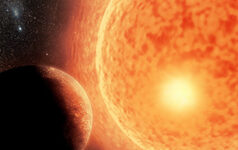
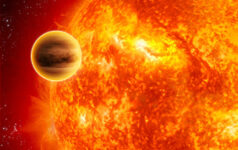
As though planets from outside our Solar System were not exciting enough, astronomers have recently discovered a planet orbiting a star from outside our galaxy Johny Setiawan reports.
Science in School is published by EIROforum, a collaboration of research organisations. Eleanor Hayes, Editor-in-Chief of Science in School, reviews some of the latest news from the EIROforum members.
Ages: not applicable; Topics: News from the EIROs, Biology, Astronomy / space, Health
Science in School is published by EIROforum, a collaboration of research organisations. Eleanor Hayes, Editor-in-Chief of Science in School, reviews some of the latest news from the EIROforum members.
Ages: not applicable; Topics: News from the EIROs, Physics, Biology, Astronomy / space
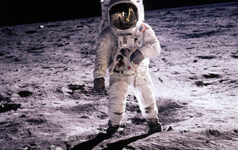
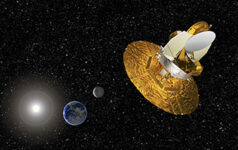
Have you ever looked up at the Moon in a clear night sky and wondered about the very few people who have walked on its surface? What did we learn, and what are we still unsure about? When might humans return to the Moon? Adam Baker investigates.
EIROforum Click to enlarge image EIROforumw1 is a collaboration between seven European inter-governmental scientific research organisations. The organisations focus on very different types of research – from molecular biology to astronomy, from fusion energy to space science. They use very…
Ages: not applicable; Topics: Physics, General science, Biology, Astronomy / space
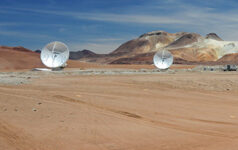
Claudia Mignone and Douglas Pierce-Price take us on a trip to the Chilean Andes, to the site of ALMA, the world’s largest radio astronomy facility, which is set to discover the secrets of our cosmic origins.
French astrophysicist Pierre Léna talks to Marlene Rau about science education as a symphony, the importance of curiosity, and his commitment to spreading inquiry-based science teaching in Europe and beyond.
Ages: not applicable; Topics: Astronomy / space, General science, Science and society
Malcolm Fridlund from the European Space Agency (ESA) describes the search for extra-solar planets and explains how they can help us to understand the origin of life on Earth.
Ages: 14-16, 16-19; Topics: Physics, Chemistry, Astronomy / space
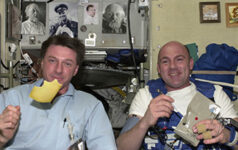
How do astronauts eat, sleep and wash? Can you get ‘seasick’ in space? In the second of two articles about the ISS, Shamim Hartevelt-Velani, Carl Walker and Benny Elmann-Larsen from the European Space Agency investigate.