
Science Learning Centres: training for teachers Inspire article
Anna Gawthorp describes the creation of the ambitious Science Learning Centres network to help UK teachers, technicians and classroom assistants to make UK science education world-class.
Why was the network created?
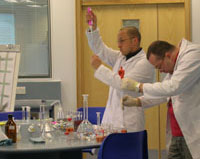
Learning Centres
England’s national data tells a contrasting story about pupils’ achievements in science. Attainment in primary and secondary schools has risen steadily over the past 10 years yet paradoxically, fewer pupils are taking the opportunity to study science after leaving school.
A recent international comparative studyw1 based at the University of Oslo asked school students about their views on science education (see Sjøberg & Schreiner, 2006). On the whole, the English students who were surveyed believe that science is important in their lives and for their future careers, and that everyone should study it. They do not find science excessively difficult, and many find it interesting, but students do not see themselves becoming scientists – and they do not enjoy science as much as other subjects.
The cause of this is not simple, as there seem to be several factors affecting students’ perception of science. In England, many teachers feel that the curriculum and assessment are now so demanding that they have little time to develop interesting practical work or to keep up with developments in their subject. Furthermore, there is a shortage of subject-specific science teachers, so that, up to the age of 16, students often have teachers qualified in a science subject that is not the one they are teaching. These teachers may not have the skills or knowledge to awaken and sustain interest in the subject.
How does the network of Science Learning Centres address these issues?
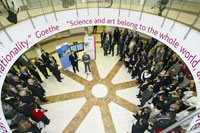
Learning Centre was
launched by Tony Blair, the
UK Prime Minister
Image courtesy of the Science
Learning Centres
The national network of Science Learning Centres has been created to address these issues, offering continuing professional development to inspire science teachers and provide them with the skills and resources to enthuse their pupils. By working with industry leaders, research scientists and scientific organisations, the Science Learning Centres offer practical scientific knowledge and experience. This is matched with educational expertise, ensuring that teachers and technicians gain professional development that is creative, intellectually stimulating and relevant in terms of both contemporary science and the classroom environment.
There are courses tailored to all groups involved in science education, recognising the contribution of many groups of professionals. Thus, courses are available not only to secondary-school science teachers and further education lecturers, but also to primary-school teachers and teaching assistants, as well as those who work outside schools, such as science co-ordinators in local education authorities.
The topics of the courses are just as varied, ranging from traditional science subjects and related subjects such as psychology and citizenship issues, to career development courses. A few examples to illustrate the diversity include ‘Inspiring Learning Through ICT’, ‘Inspiring Post-16 Chemistry’, ‘Skills for New Technicians’ and ‘Support for Laboratory Refurbishment’. In addition to courses, the Centres run lectures, networking sessions, exhibitions, conferences and many other events. All events are listed on the Science Learning Centres websitew4.
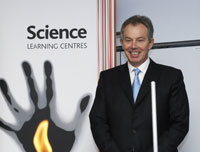
Learning Centre was
launched by Tony Blair, the
UK Prime Minister
Image courtesy of the Science
Learning Centres
To ensure the courses best meet the needs of their attendees, they are developed and delivered by a wide variety of experts. Thus on the ‘Controversial and Contemporary Science’ course, sessions are given by classroom teachers, educational researchers and academics, as well as world leaders in controversial science topics such as climate change and genomics. On a course to help schools link effectively to industry, there are trainers with various industrial backgrounds, as well as a curriculum expert.
Courses run throughout the year, but mostly during term time. In general, courses at the regional Centres last one or two days, whereas courses at the national Centre may consist of two residential periods of up to three or four days each. The focus of the regional centres is local, with courses run throughout the region, including some tailored to individual schools. By contrast, the National Science Learning Centre offers residential courses, providing access to state-of-the-art facilities for teachers from across England, Scotland, Wales and Northern Ireland.
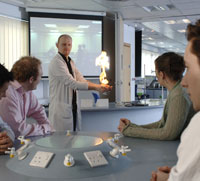
Learning Centres
Although the courses are normally paid for from the school’s training budget, there are often bursaries and discount schemes available to help pay for all or part of a course. Some include a contribution towards the cost of a replacement teacher at school for the duration of the course.
To enable the teachers – and their students – to continue to benefit from the training after the course has finished, almost all courses have a range of associated resources. Many are provided free of charge to attendees and are usually available online to delegates after the course. To further widen their impact, the Science Learning Centres are currently developing an online resource bank that will be launched soonw4. This library will include everything from helpful tips, games, worksheets, slides and classroom activities created by fellow teachers, to relevant government documents or research papers, or links to the best science education websites.
In their first year of operation, the Science Learning Centres delivered over 10,000 days of training. Although an independent evaluation to investigate the impact in schools is ongoing, initial feedback from teachers has been very positive: “This has renewed my enthusiasm for the job that I do”(science technician); “This course has far exceeded any expectations I had – it may have saved my career” (head of science).
The Science Learning Centres network
The Science Learning Centres network is a unique £51 million joint initiative by the UK’s Department for Education and Skillsw2 and the Wellcome Trustw3, the UK’s largest medical research charity, and is made up of nine regional Science Learning Centres and a national Centre which is based at the University of York. Each of the Centres is run by a regional partnership, awarded the contract following a competitive bid process, involving at least one university partner with additional involvement from industrial and research establishments.
The regional Science Learning Centres will be funded by the Department for Education and Skills until 2008 and aim to become self-sustaining in that time. The National Science Learning Centre will be funded by the Wellcome Trust until 2013, by which time it too should be self-sustaining.
References
- Sjøberg S, Schreiner C (2006) How do students perceive science and technology? Science in School 1: 66-69.
Web References
- w1 – For further information about ROSE, an international comparative study that investigates the diversity of interests, experiences, priorities, hopes and attitudes that children in different countries bring to school or have developed at school, see www.ils.uio.no/english/rose
- w2 – The UK government’s Department for Education and Skills (DfES)
- w3 – The Wellcome Trust is the UK’s largest medical research charity funding research into human and animal health.
- w4 – More information about the Science Learning Centres is available here: www.sciencelearningcentres.org.uk
Review
This interesting and appealing article describes a possible answer to a crisis that is common to all of Europe. The continuation of teachers’ skills improvement and professional education is an issue rarely considered by governments and decision-makers, but extremely important and decisive for providing teachers with the ability to communicate their knowledge and to stimulate pupils.
The UK experience can provide a solution, allowing teachers to continue their professional education and re-lighting their fire of motivation. Science Learning Centres represent a good example for decision-makers in other European countries to follow.
Marco Nicolini, Italy