
Spiders in Space : a collaboration between education and research Teach article
An ambitious Australian school project sent spiders into space to experience microgravity. 'Spiders in Space' will form the basis of a future project involving many more schools worldwide. Lachlan Thompson and Naomi Mathers, from RMIT University in Melbourne, Australia, explain how it all started.
training for the mission
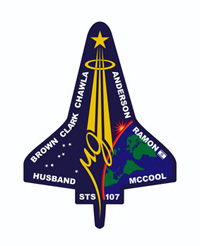
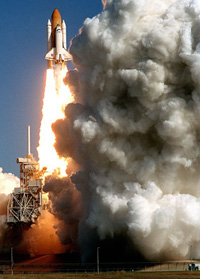
On 16 January 2003, eight Australian spiders embarked on a 16-day mission into space on board the space shuttle Columbia STS-107. The experiment was the culmination of a three-year collaborative programme between students from Glen Waverley Secondary College, RMIT University and the Royal Melbourne Zoo (Thompson et al., 2000),and put the students in direct contact with established space entities NASA, BioServe and SPACEHAB as well as with international researchers.
The students were involved in all aspects of the design of the experiment as well as in investigations into issues such flight clearance and mission simulation.
Despite the tragic loss of Columbia and her crew during the STS-107 mission, the project highlighted the educational benefits of school students being part of a real-life space science project.
Introduction
One of the greatest community benefits resulting from NASA’s space shuttle programme has been education. Examination of previous shuttle missions found there was often excess payload capacity that could be used for small educational experiments. A NASA initiative to make use of this capacity enabled a number of schools in the USA to play an active role in space research.
In the late 1990s, NASA contracted out its commercial space research to SPACEHAB, Inc. This provided an opportunity for SPACEHAB to offer commercial education experiment programmes and resulted in the Space Technology and Research Students (STARS) programme.
The STARS experiments flown on STS-107 came from participating schools from the USA, Australia, Canada, Japan, China, and Israel (Goulart et al., 2005).
With the support of scientists and other professionals, each class was responsible for developing their own experiment and liaising with the launch-provider SPACEHAB, the public and other schools.
The research topic chosen for the Australian experiment was ‘Spiders in Space: the effect of microgravity on spider behaviour and web composition’. Spiders had previously flown into space on Skylab 3 in 1973, but the two spiders died before the experiment was completed (Witt et al., 1977). Scientists at RMIT University chose this topic for its accessibility and appeal to students across a broad range of ages and capabilities.
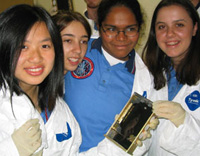
spider habitat at the
Astrotech Facility in
Titusville, FL, USA
The experiment aimed to add to the current body of knowledge on the biological effects of microgravity on living organisms, with particular focus on web-building and the microstructure of spider silk spun in microgravity. Gravity is believed to have a strong influence on behaviour, particularly on the way they move and build their webs. Gravity is also thought to influence the thickness of their silk and the ‘north-south’ asymmetry of their webs, and to help them to orient themselves, particularly when rebuilding webs that have been disturbed.
The class as a whole developed the mission-specific hypothesis that ‘a spider will build a different web in microgravity than on earth’. This was to be investigated by observing differences in shape, pattern and silk thickness.
The class of 26 Year-9 students (14-15-years old) formed groups to examine the core areas of the project: animal husbandry, habitat development, mission protocols, ‘spidernaut’ training, instrumentation, media and communications.
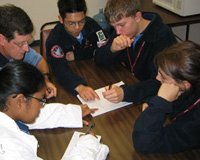
best spidernauts
From the development of the mission hypothesis, each research group set out to conduct a series of experiments to develop the mission specifications. This included selecting the species of spider, spider size and age, lighting, food and feeding mechanisms and habitat features to encourage web-building.
The isolated nature of the experiment encouraged students to anticipate and plan for complications such as spider redundancy (how to carry one or more back-up spiders), failure of the feeding mechanism and whether mechanical or biological feeding techniques should be used.
Students were required to interact with SPACEHAB in the USA through the protocols of experiment approval, hardware definition, live materials list, experimental protocol, ‘delta phase three’ clearance (flight approval), and mission simulation.
‘Spiders in Space’ in the school curriculum
To facilitate the introduction of a major project into the classroom, a curriculum was developed that identified the key topics in the research project and the student tasks which met the educational, teaching and learning objectives for Year 9 sciences. Most of the normal science curriculum (Board of Studies, 1999) could be blended into the project. The project ran with the same students for three years, starting in 2000 and concluding in June 2003. When the students entered Years 10 and 11, the spider project was completed after hours in addition to their normal classwork.
RMIT University and the Zoo provided scientist mentors one day per week for the duration of the project. Team groups met for 30 minutes each week to review overall progress.
The spider experiment allowed a wide range of spin-off pre-flight experiments and activities such as:
- breeding spiders;
- ‘training’ spiders for flight conditions;
- pre-flight environmental conditioning;
- developing and constructing spider habitat;
- developing appropriate lighting for viewing and photographing the webs;
- designing and testing automated feeding mechanisms;
- performing control and flight experiments.
To engage the broader school community, the class commissioned spider habitat boxes from the technology classes, and obtained video cameras and lighting from the electronics classes. A competition was run for Year-11 and -12 students to design the school mission patch.
Results from STS-107 Columbia
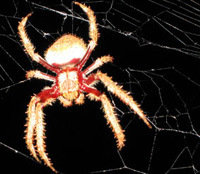
The garden orb-weaver spiders (Eriophora transmarina) were monitored day and night with still and video cameras. The night photography was the most useful, as spiders are nocturnal. Excellent images were taken of the spider during its web-making. This allowed the class to examine the spider’s web-making prowess.
While eight spiders flew on Columbia, a second spidernaut team was undergoing the control experiment in an identical locker box and habitat on earth. In both habitats, the spidernauts were provided with food by placing fruit-fly larvae in agar gel at the base of their habitat. The flies were recorded on video emerging from their pupae in both the Columbia and the ground control experiment. This biological feeding process was shown to be a viable mechanism to sustain the spiders.
Comparing the performance of the two lead spiders showed that Wako in microgravity was able to construct her web in just over half the time it took her land-based control, Cadbury. A video of Wako shows the spider manoeuvring more deftly on the web than the earth-bound Cadbury. Other observed differences in web shape supported observations made on Skylab 3 (Witt et al., 1977).
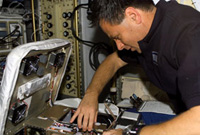
payload specialist Ilan
Ramon, prepares to take a
web sample on day 8 of
Columbia’s mission.
Photo courtesy of NASA
During the mission, experimental data were downloaded to mission control and made available to the research team. The Columbia crew worked particularly closely with the student experiments. Israel’s first astronaut, payload specialist Ilan Ramon, released the back-up spiders and took web samples. His observations, comments and insights, transmitted during the mission, conveyed his pleasure in working on the experiment and led to a close bond between the ‘Spiders in Space’ team and the Columbia crew.
Further analysis was thwarted by the loss of Columbia, her crew and significant data, including the high-definition images of the spider-webs, the spiders and the web samples.
Research and teaching outcomes
The outcomes of the experiment have broad applications. Investigation and development of life-support systems for spiders and similar life-forms in space contribute to the knowledge necessary to support ecosystems in space.
Observing how the spiders learn to move without the aid of gravity and how they develop new techniques for web-building provides insights into techniques for building structures in microgravity. For example, the two-dimensional nature of the spider-web is comparable to the large planar structures used to support solar arrays.
In developing their hypothesis and designing the experiment, the students gained insights into the role of science in our community. They developed individual expertise and an understanding of the responsibility of scientists to disseminate their findings within the scientific and broader community.
The students were required to conduct independent research activities and apply problem-solving skills to real-life situations. Some of the concepts that they encountered during the course of the project include:
- the relationship between weight perception and the structure and microstructure of the web;
- the role of gravity in orientation and web-building;
- adaptation to and movement in conditions of microgravity;
- the phenomenon of fluid shift and other aspects of health in space;
- spider biology and behaviour;
- experimental techniques and validation;
- the use of clinorotation to simulate weightlessness;
- running an experiment with contingency planning and minimal human intervention;
- building a mini-space ecosystem;
- the development of a biological feeder;
- life-support requirements in a space environment;
- shuttle missions: procedures, deadlines, simulations, live materials list, awareness of factors influencing shuttle launches;
- objective analysis of experimental results;
- transfer and sharing of findings with other researchers;
- working with professional scientists, astronauts and technicians to solve complex scientific problems;
- communicating the results of experiments to the professional scientific community.
Epilogue
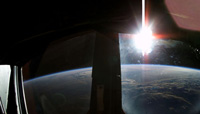
above the earth
The tragic loss of Columbia and her crew on 1 February 2003 stunned the world as debris was scattered across the southern USA. With the death of the Columbia crew, science became personal for the ‘Spiders in Space’ team. What should have been a joyous celebration of Columbia’s successful return was characterised instead by shock, horror and grief. A harsh lesson that science challenges the frontiers of human achievement – driving individuals and teams – but that the pursuit of that achievement is not without risk.
“Our team has been driven by the loss of the crew of Columbia to complete and publish the experiment results as a tribute to the seven astronauts” – Greg Carstairs, student.
‘Bees in Space’
‘Spiders in Space’ will be followed by a much larger space experiment, ‘Bees in Space’. Expressions of interest are being accepted from schools worldwide. To find out more about the project, contact Naomi Mathers at naomi.mathers@rmit.edu.au, or Lachlan Thompson at lachlan.thompson@rmit.edu.au.
In future issues of Science in School, you can read about:
- how the ‘Spiders in Space’ project was developed as an interdisciplinary project between a school, a university and a zoo;
- how to get involved in ‘Bees in Space’, the new worldwide project.
References
- Board of Studies (1999) Curriculum and Standards Framework II. East Melbourne, Vic, Australia: Victorian Curriculum and Assessment Authority
- Goulart CV, Woodard S, Campbell K (2005) STARS™ (Science Technology and Research Students): A Hands-On, Interactive, Scientific and Cultural Exchange Lesson. SAE Technical Paper 2005-01-3102. Warrendale, PA, USA: SAE International
- NASA (1999) Proceedings of the 1999 Shuttle Small Payloads Symposium. CP-1999-209476. Washington, DC, USA: National Aeronautics and Space Administration
- Thompson LA, Rudov-Clark S, Diadematus AS (2000) ‘Spiders in Space’ – Space Science in Australian Schools. 6th Australian Space Development Conference; 19 July; Adelaide, SA, Australia
- Witt PN et al. (1977) Spider web-building in outer space: evaluation of records from the Skylab spider experiment. Journal of Arachnology 4: 115-124
Review
This interesting and informative article describes a three-year educational project between scientists and school pupils that was set up to investigate the influence of gravity on spider silk and web-making. Students worked and met with scientists, which enabled the students to understand and appreciate the wide range of skills that are involved in setting up a project, for example design technology, information technology and biological knowledge. Students were encouraged to develop experimental-design skills that included learning the importance of pilot experiments to test methodology and equipment. The use of live subjects and the loss of the Columbia mission showed the students how frustrating research can be.
The project provides examples of both how the school science curriculum can be extended and how novel projects can be incorporated successfully within a national curriculum. Students could be set the challenge of designing similar novel experiments via group work and/or classroom discussion or applying to participate in the ‘Bees in Space’ project. This would stimulate their imaginations, a prerequisite for carrying out novel research, and would show how scientists in different subject areas need to collaborate for a successful outcome.
The article may be linked to other topics in biology, for example, the different types of spider silk, the effect of drugs on spiders and web production, and problems associated with breeding programmes such as genetics or habitats. This would broaden the horizons of students and teachers and may encourage them to be more curious about the world.
Shelley Goodman, UK